
More Than a Credential
For Richard Hardin, earning his NABCEP PV Associate credential meant gaining technical knowledge, professional credibility, and a new perspective on the solar industry.
July 24, 2026
Not every career in renewable energy begins with a degree in engineering or a job in solar.
For Richard Hardin, the journey started in the Marine Corps Reserves, continued in the construction trades, and eventually led to a career supporting some of the nation’s largest utility-scale solar projects.
Along the way, each step gave him a broader perspective on the industry he now calls home.
“I have a very non-traditional career path, I guess,” Hardin said. “Most people get out of high school, go to college, and get into some sort of professional sales career. That was not my path at all.”
After high school, Richard joined the Marine Corps Reserves before becoming a union carpenter. Years of physically demanding work eventually convinced him it was time for a change, and he transitioned into sales, first at a lumber company and later at a vinyl wrap manufacturer. But it wasn’t until he joined Greentech Renewables that he found an industry he was passionate about.
“That was my first introduction to the renewable energy industry. Then I fell in love with it,” Hardin said.
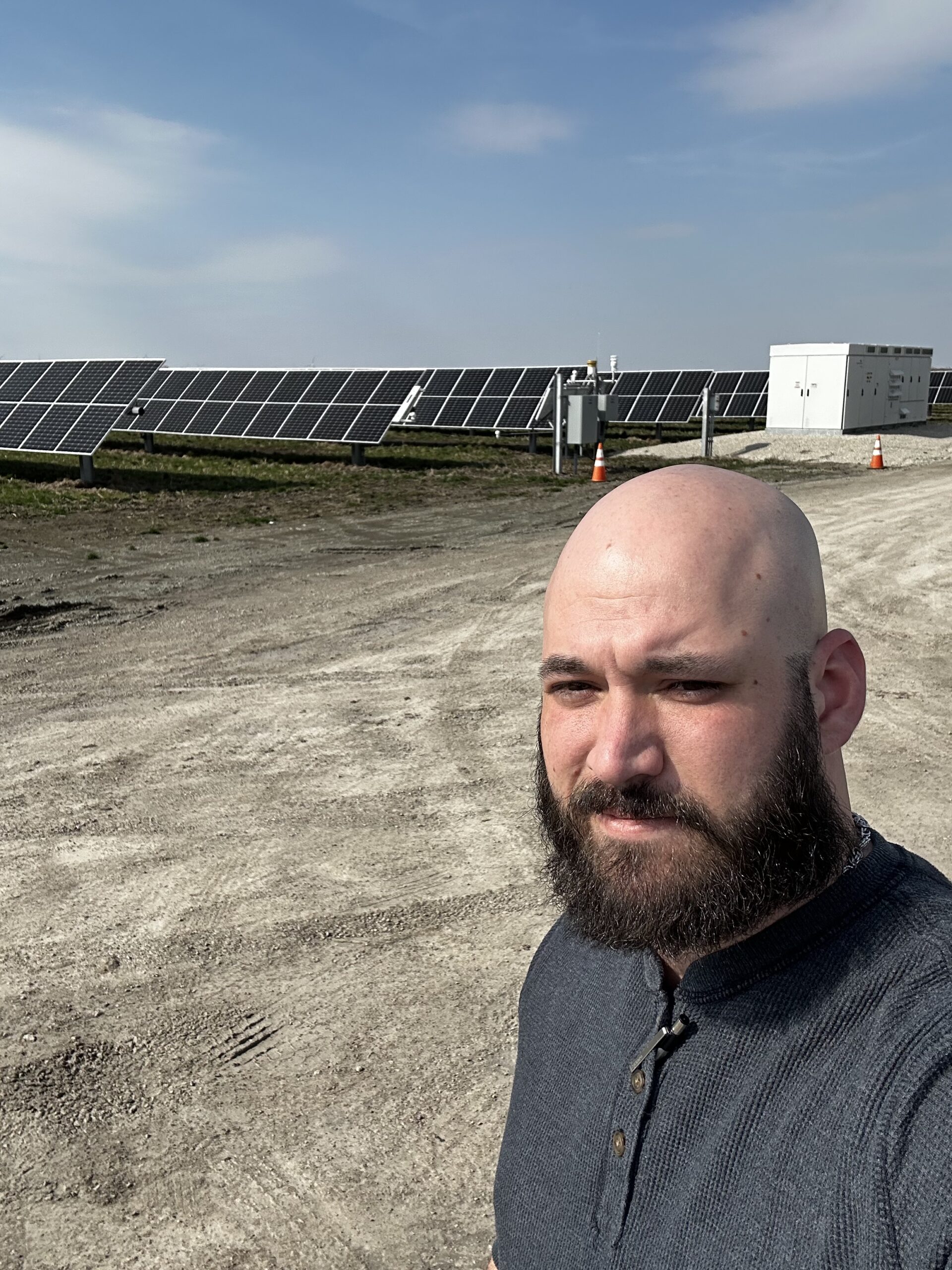
Today, Richard works for ULE Group supporting utility-scale solar projects. Along the way, completing the MREA’s PV Associate Core Course Package and earning his NABCEP PV Associate credential helped strengthen his technical knowledge and professional credibility.
Earning his credential wasn’t just about expanding his own knowledge — it also helped build confidence with customers. “The credential gives customers confidence in my knowledge,” Hardin said. “I can say to customers, you don’t have to just trust my word, you can trust this credential.”
When Richard attended the MREA’s weeklong PV Associate Core Course Package, he already had five years of experience in the solar industry. Rather than starting from scratch, the course reinforced what he knew while introducing him to perspectives he hadn’t encountered before.
The early part of the course gave him an opportunity to review the fundamentals while asking more advanced questions of instructors with decades of experience. “Being able to bounce some higher-level ideas off of the instructors was really, really nice. The instructors are knowledgeable, and they know what they’re doing. They’ve been around this industry for a couple decades, so it was nice to be able to have those conversations with them,” Hardin said.
Although Richard has spent his career on the distribution side of the solar industry, he found the lessons on residential design and sales especially valuable. “I have a better understanding of what my customers go through on a day-to-day,” he said. “It’s been really nice and eye-opening to understand somebody else’s perspective. It helps me do my job a lot better.”
While the technical knowledge was valuable, one of the biggest takeaways for Richard was the people behind the program. “I really want to emphasize how personal, helpful, and available everybody at the MREA is. If you have any questions or any concerns, they’re there to help you,” Richard said.
Whether you’re new to solar or looking to expand your expertise, the MREA’s PV Associate Core Course Package provides the technical foundation, practical skills, and industry connections to help you take the next step. Richard’s advice to others considering the program is simple: “Absolutely. 100 percent.”
MREA Training Programs
The Midwest Renewable Energy Association (MREA) provides industry-leading renewable energy training designed for professionals at every stage of their careers. Whether you’re new to the industry or looking to expand your expertise, MREA offers flexible online and in-person courses in solar photovoltaics, energy storage, electric vehicle infrastructure, and other clean energy technologies. From foundational training and NABCEP exam preparation to advanced technical coursework and continuing education, MREA’s expert-led programs equip students with the knowledge and hands-on skills needed to succeed in the rapidly growing clean energy workforce.